

The results released late Wednesday provide a pulse on the frantic spending on artificial intelligence technology, which has been driving the stock market and the overall economy since OpenAI released ChatGPT three years ago.
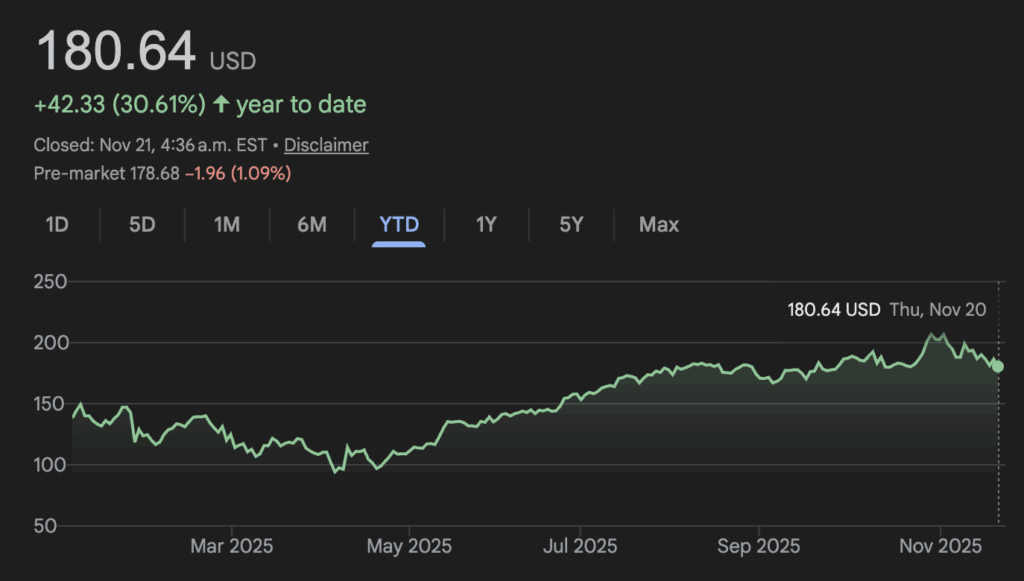
Nvidia has so far been the biggest beneficiary of the rally as its processors have become indispensable for building the artificial intelligence factories required for the most dramatic technological shift since Apple released the iPhone in 2007. But over the past few weeks, there’s been a growing sentiment that high expectations for artificial intelligence may have become too frothy, setting the stage for a stunning decline that could be as dramatic as Nvidia’s rise from a company with a market cap below that of the company. It was worth $4.5 trillion at the close of trading on Wednesday, compared with $400 billion three years ago.
Nvidia’s fiscal third-quarter report, which covers the August-October period, provided relief to those fearing the worst and could help reverse the recent stock market slump.
“The market should be heaving a sigh of relief given the jitters we’ve been experiencing,” said Sean O’Hara, president of investment firm Pacer ETFs.
The company’s shares rose more than 5% in extended trading on Wednesday after the data was released. If stocks trade similarly on Thursday, it could result in a one-day increase in shareholder wealth of about $230 billion.
Nvidia earned $31.9 billion, or $1.30 per share, an increase of 65% from the same period last year, and revenue increased 62% to $57 billion. Analysts polled by FactSet Research expected earnings of $1.26 per share and revenue of $54.9 billion. What’s more, the Santa Clara, California-based company expects revenue of about $65 billion in the November-January quarter, nearly $3 billion higher than analysts’ forecasts and a sign that demand for its AI chips remains strong.
Nvidia CEO Jensen Huang said in a prepared statement that orders for Nvidia’s top-tier Blackwell chips are “record-breaking” and described current market conditions as a “virtuous cycle.” Nvidia Chief Financial Officer Collette Kress said on a conference call that by the end of next year, the company will have sold about $500 billion in chips designed for artificial intelligence factories in 24 months. Kress also predicts that trillions more will be spent by the end of the 2020s.
In a preface to a conference call, Huang seized on the moment to push back against skeptics who doubted his argument that technology is at an inflection point that will change the world. “There’s been a lot of talk about the AI bubble. From our perspective, we’re seeing something very different,” Huang insisted as he celebrated the “depth and breadth” of Nvidia’s growth.
The article continues as follows
X
The upbeat results, upbeat comments and reassuring reactions reflect Nvidia’s key role in the future direction of the economy – a position that Huang has used to build a close relationship with President Donald Trump even as the trade war waged by the White House inhibits the company’s ability to sell its chips in China’s fertile market.
Trump has increasingly relied on developments in the tech industry and artificial intelligence to pursue his economic agenda. Despite Trump’s claims that his tariffs are bringing in new investment, much of the foreign capital is flowing into data centers to feed the computing needs of artificial intelligence or the power infrastructure needed to run them.
“To say this is the most important stock in the world is an understatement,” Jay Woods, chief market strategist at investment bank Freedom Capital Markets, said of Nvidia.
The boom isn’t just a boon for Nvidia, which a few weeks ago became the first company to be worth more than $5 trillion before recent bubble concerns sent its stock down more than 10%. Their fortunes have soared as OpenAI and other big tech giants snap up Nvidia’s chips to build their artificial intelligence factories and invest in other services related to the technology. Apple, Microsoft, Google parent Alphabet Inc. and Amazon all have market capitalizations between $2 trillion and $4 trillion.
Refrigerator problems cut into fourth-quarter profit, Metro says costs will persist into first quarter
Metro Inc. (TSX:MRU)
Data for the fourth quarter of 2025:
- profit: $217 million (down from $219.9 million a year ago)
- income: $5.11 billion (up from $4.94 billion)
Grocery and drugstore retailer Metro Inc. took a cost hit in the fourth quarter from problems at its Toronto frozen food distribution center, with the financial impact expected to last into the first quarter. The company said the plant resumed operations last week after being shut down for nearly two months, but the temporary shutdown cost $22.5 million in the fourth quarter as annual profits fell slightly.
Metro CEO Eric La Flèche said the company expects distribution centers to be largely back to normal by the end of December. “I would like to thank all of our teams who continue to execute our contingency plans to keep supply in our stores to minimize the impact on customers,” he said in a statement on Wednesday.
On September 12, Metro was forced to stop work at its frozen food distribution center in Toronto due to problems with the refrigeration system. The plant resumed operations on November 10. La Flèche said by phone that the problems with the refrigeration system were mechanical and not automation-related. He added that the company is currently working with insurance companies to determine how much it can recover.
“Looking ahead to the first quarter of 2026, we estimate that direct costs associated with leasing temporary cooling equipment and executing contingency plans will impact our net income by approximately $15 million to $20 million,” Chief Financial Officer Nicolas Amyot said on a conference call Wednesday.


