

The number of stocks traded in the United States today is about half what it was in 1996 – 4,010 versus 8,090.
Fewer public companies mean less economic activity for everyday investors to participate in.
Passive index investing is becoming less diversified and more concentrated, as the 10 largest companies (Nvidia, Microsoft, Apple, Alphabet, etc.) now make up an all-time high of about 41% of the S&P 500 (for total market funds like VTI, it’s about 34%).
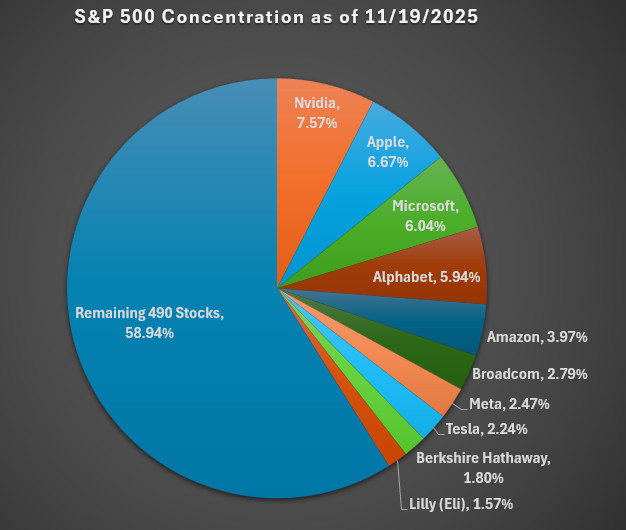
This is because the underlying index is weighted. So when Nvidia’s stock rises (and, of course, it’s printing money), it becomes a larger portion of the S&P 500 and market capitalization.
This is significant for public market investors. Incredible gains for stocks like Nvidia and Tesla offset hundreds of companies that didn’t contribute much to earnings.
But record highs in index concentration suggest a reversal is inevitable.
Concentration isn’t the only shift happening in markets.
At the same time, many of the fastest-growing companies of our time remain private.
Consider recent private valuations:
- Open AI – $500 billion
- SpaceX – $400 billion
- Human costs – $350 billion
- xAI – $230 billion
- Databricks – $130 billion
- Stripe – $100 billion
- Graph AI (robots) – $39 billion
These are all American companies, but none are listed.
Ten years ago, these either didn’t exist or were worth less than a few billion.
That more than a trillion dollars in gains went not to retail investors but to founders, employees (a disproportionate number in the San Francisco area), venture capital firms and their already wealthy clients.
These “startups” are leading the trend of private companies staying private longer.
When asked, they said it was due to regulatory and compliance issues or Wall Street scrutiny, and they preferred to focus on growth rather than hitting quarterly estimates.
In fact, these companies remain private because they can efficiently raise the capital they need and provide liquidity to employees and early investors in private markets.
Private markets also tend to support higher valuations because pricing is opaque and driven by negotiated financing rounds rather than daily public transactions.
The number of public shares has declined for other reasons. Private equity firms have been buying up companies and delisting them, larger companies have been absorbing smaller rivals, and then Enron regulations made going public more expensive.
Combined with large amounts of venture capital and higher private valuations, young companies simply have no incentive to go public.
Even if our equity funds are “diversified,” a reduction in the number of listed companies means less financial risk for retail investors.
As the venture-backed world (which largely excludes retail investors and retirement accounts) grows, elite VC firms earn more and reinvest the proceeds into the next generation of the fastest-growing, most disruptive startups like Cursor, Mercor, Anduril, Ripple, Polymarket, Kalshi, Harvey, and more.
The next wave of $100 billion companies may emerge from private companies rather than public companies.
Retail investors will once again be shut out of many growth stories unless the SEC takes action:
- Reducing reporting and compliance burdens on public companies.
- Prevent shareholder proposals and litigation risks and encourage more IPOs.
- Modify the definition of certification to allow more investors to participate in the pre-IPO economy.
- Open the secondary pre-IPO market to more retail investors by “tokenizing” private companies – using blockchain and crypto to enable 24/7 trading of real-world assets.
while maintaining oversight and investor protection.
SEC Chairman Paul Atkins said the changes are coming.
Until then, index investors owned fewer stocks and had a higher concentration of risk.
At the same time, retail investors (and all the funds and institutions in which we invest) are missing out on a significant portion of economic growth.
Is this really a problem?
Today, that doesn’t appear to be the case, as anyone investing in the public markets is making money.
But we all know that’s not always the case.
Additionally, venture capital investors are making more money. Since the asset class is mostly only available to accredited and well-connected investors, this trend is exacerbating the gap between rich and poor.
People who don’t invest in stocks will feel the pain of missing out. Anyone competing to buy a home in San Francisco is also frustrated.
So what should retail investors do?
For many of us with a long-term investing horizon, that’s okay.
Long-term performance data tells us that as our investment horizon extends, stock market returns will perform in the 9%-10% range.
Even if imbalances arise due to the AI and fintech boom or unforeseen black swans, markets have a way of shaking themselves off and reverting to the mean.
History shows that when it comes to a U.S. stock market or S&P 500 retirement portfolio balanced with an age-appropriate allocation to bonds and global stocks, patient investors can weather most storms.
But of course, investors (both professional and DIY) like to configure their portfolios to protect and profit from market imbalances.
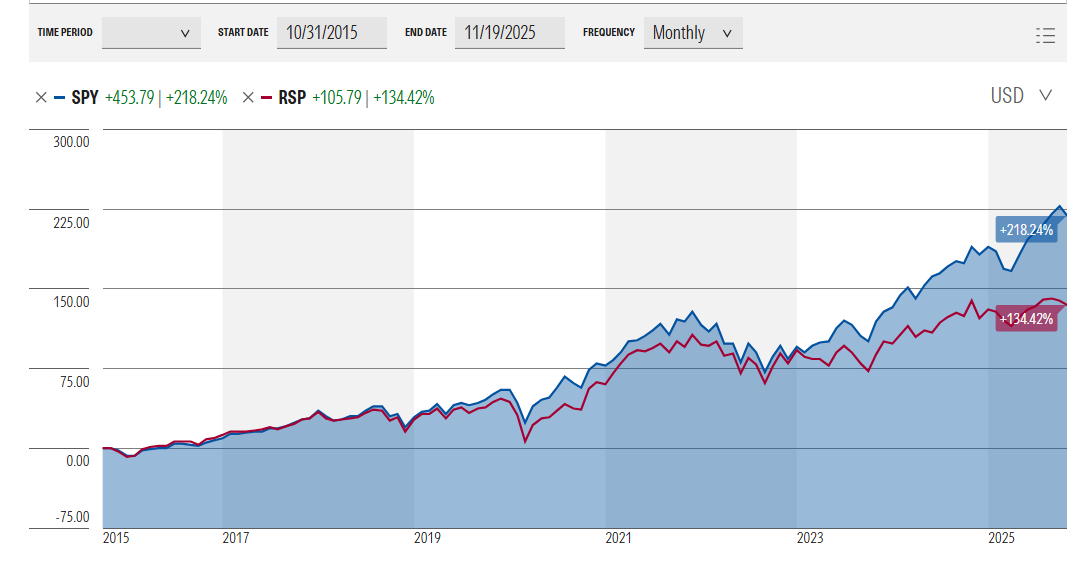
One way to deal with concentration risk is to use some, but not all, of your portfolio to hold an equal-weighted S&P 500 index fund (such as the Invesco S&P 500 Equal-Weight ETF – symbol “RSP”).
Logically, this RSP has historically underperformed because it doesn’t hold enough Nvidia or Tesla stock.
But with concentration at an all-time high (risky or not), some less passive investors may find it appropriate to hedge while continuing to invest in Top 500 public companies.
Another option is to increase exposure to international, U.S. small and mid-cap stocks. These companies won’t be immune when the market goes into trouble, but it could be worse.
For the more ambitious investor (for better or worse), as I explained in my four-day mini-course, I am okay with cautious speculation of no more than 5% of your invested assets, that is, investing based on the research you have done or the knowledge you have about the industry, which may lead to profits above market returns.
My favorite way to “speculate” is to look for opportunities to invest in private companies that are growing but not yet public. As an accredited investor in the United States, I have more options than a non-accredited investor.
However, so far I have avoided investing directly in popular pre-IPO companies on the secondary market, e.g. honeycomb* and EquityZen due to increased risk, complexity and higher minimum investment.
Instead, I invest in venture capital through diversified funds provided by: Fengsheng Venture Capital* and ARK Venture Fund (available at SoFi Invest).
These investments provide access to the fastest-growing venture capital firms in artificial intelligence, defense and fintech, with low investment minimums and a broad range of investments.
Although the fees are higher and only quarterly liquidity applies, the trade-off is worth it to me. I have been involved in the growth of some of the outstanding private companies mentioned above.
These types of companies have been going public twenty years ago. Today, we need to find other avenues for investment. Otherwise, the innovation and profits that occur will only benefit those with significant wealth and connections.
That is, until the SEC and lawmakers take action. I’m not holding my breath.
Public markets are shrinking, private markets are exploding, and ordinary investors are getting only a piece of U.S. economic growth.
That doesn’t mean the index fund strategy is dead—it still works. But if more of the fastest-growing companies remain private, taking market share from public companies, and acquisitions continue, the reliability of passive index strategies could be undermined.
*Please note: This is a testament to a partnership with Fundrise and Hiive. We earn commissions from affiliate links on RetireBeforeDad.com. All opinions are my own.

Craig Stephens
Craig is a former IT professional who gave up a 19-year career to become a full-time financial writer. He has been a DIY investor since 1995 and started Retire Before Dad in 2013 as a creative outlet to share his portfolio. Craig studied finance at Michigan State University and lives in northern Virginia with his wife and three children. Read more.
Favorite tools and investment services (sponsored):
Bolding — Spreadsheets are not enough. Build financial confidence. (review)
projection lab — Create a financial plan that you like. (review)
Empower — Free net worth and portfolio tracking + retirement planning. User since 2015.
Determine dividends — Free download to research dividend stocks (review):


