

I follow an X/Twitter account that posts the following chart regularly and updates it frequently.
This chart compares the performance of the Nasdaq from Netscape’s launch in 1994 through 2000 (the peak of the dot-com bubble) with the performance of ChatGPT since its launch in late November 2022 (red).
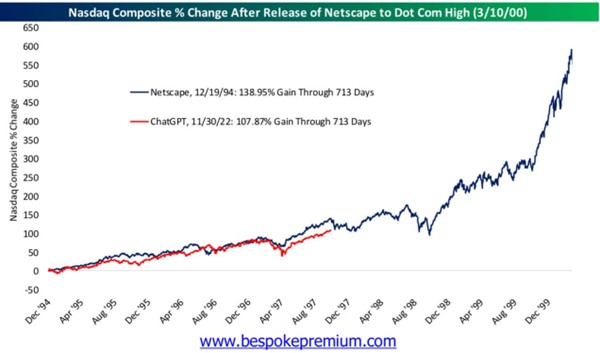
The release of Netscape in December 1994 marked the beginning of the Internet era.
ChatGPT was released on November 30, 2022, marking the beginning of the era of investable artificial intelligence (AI).
On December 5, 1996, as the dot-com bubble grew, Federal Reserve Chairman Alan Greenspan coined the term “irrational exuberance” to warn investors that markets might be overvalued.
It took more than three years So that the bubble bursts.
I bring this up now because famous market valuation metrics like the Shiller P/E ratio and the Buffett indicator suggest that the market is overvalued.
But experts, banks and tech leaders think otherwise.
Massive investment in AI infrastructure is only just beginning as Mag 7 companies and their bulletproof balance sheets pour capital to avoid falling behind in the AI era.
Retail investors have easy access to stocks and other assets.
Compared to 1999, more investors and money are flooding into the market.
At the same time, as startups stay private longer, the number of public companies available for investment has shrunk (about 4,300 stocks, compared with about 7,300 in 1996).
The index is being driven higher by a handful of market leaders, including Nvidia, Oracle, Meta, Alphabet and Microsoft, which are investing their balance sheets in AI infrastructure.
Additionally, startups like OpenAI and Anthropic are attracting venture capital and investing in infrastructure.
No one can predict a market top or bottom; we can only go with the flow. But over the long term, the market’s history is remarkable.
That’s why DIY investors should stay the course and cost-average into the market through an employer account or regular investments in a Roth or IRA.
People who need cash outlays in the short term (1-2 years) should keep cash in case of market events.
It may be tempting to become cautious or try to predict a crash and cash out, but as noted mutual fund manager Peter Lynch said in September 1995:
Investors lose far more money preparing for or anticipating a correction than they lose from the correction itself.
History doesn’t exactly repeat itself, but it tends to rhyme — and for patient investors, that rhythm still favors those who stay invested through every cycle.
Featured images are from deposit photos used with permission.

Craig Stephens
Craig is a former IT professional who gave up a 19-year career to become a full-time financial writer. He has been a DIY investor since 1995 and started Retire Before Dad in 2013 as a creative outlet to share his portfolio. Craig studied finance at Michigan State University and lives in northern Virginia with his wife and three children. Read more.
Favorite tools and investment services (sponsored):
Bolding — Spreadsheets are not enough. Build financial confidence. (review)
projection lab — Create a financial plan that you like. (review)
Empower — Free net worth and portfolio tracking + retirement planning. User since 2015.
Determine dividends — Free download to research dividend stocks (review):


